5000 years ago...
Hey everybody,
We were already planning our next vacation on our flight back from Nicaragua. Dawn has had a bug in her ear (bahahaha) about Malta for a while ever since reading about it and finding out it was a location for the first couple of seasons of Game of Thrones. We could easily jump over from Malta to Sicily and after that there was an implied threat of death or at minimum debilitating pain if we did not spend at least a couple of days in Rome. Itinerary set: It’s go time. And… almost exactly one month after we booked our flight the Azure Window collapsed.
Mdina Travel tip #56: Do not rent a car in a country that has left-side driving if you’re running on 27 hours with no sleep and it’s raining. I do these things for you, dear reader, so that you may learn from my mistakes. Our desperation was such that we resorted to having Dawn navigate to our BnB. Yes, I know… it sent chills down my spine too. We booked a place right outside of Rabat with a lovely pool which doubled as a prolific mosquito breeding ground. Our first days were a dreary, rainy, jetlag-induced haze mostly wandering around Rabat and Mdina. The Rabat city center is a labyrinth of narrow streets leading to the church of St. Paul in the center. The roads curve and intersect at odd angles so when you’re driving it’s impossible to know if anything is coming at you from around the corner. We spent quite a bit of time wandering grocery stores and bakeries hunting for snacks and finding things like chicken chips, oreo donuts, some unpronounceable spice crackers and Malta’s famous pastizzi: Small puff pastries filled with spinach or ricotta or meat. You can also upgrade to a qassatat which is a 2 lb pie that’s filled with ricotta and leaves you feeling like you ingested a bag of cement. In a good way. After that we spent the rest of the afternoon walking around the tiny medieval village of Mdina, whose narrow streets and walled fortifications you can probably thoroughly explore in less than a couple of hours. I don’t know what it is about walled cities that is so damned cool. Maybe it’s that you can immerse yourself in these cobblestone labyrinths until you find a deserted stretch where you can truly imagine what it was like to walk these streets hundreds of years ago.
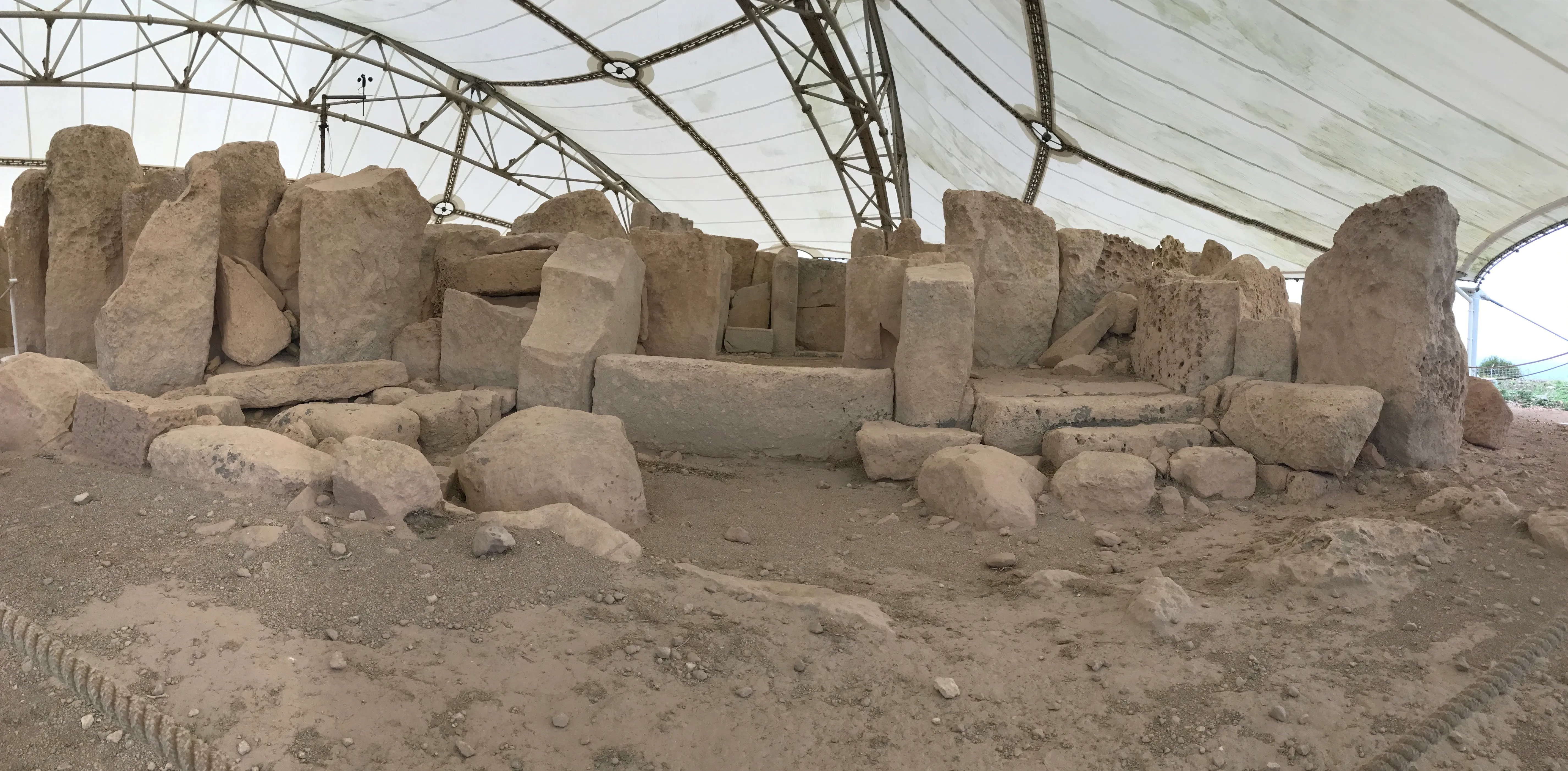
Stormy weather, a busted airplane and a six hour delay couldn’t keep Rich and Cari out of Malta. Our first rainy day together we met at the famed 5000 year-old megaliths of Ħaġar Qim and Mnajdra. They didn’t arrive in time to enjoy the 4D introductory movie that Dawn and I were lucky to experience. What makes it 4D you ask? Well, when they simulate a storm by spraying mist in your face using high-powered fans… that’s 4D. Honestly, though, the movie was surprisingly informative although it paled in comparison to the actual experience of walking through the megaliths. Both temple structures were built in approximately 3500 BCE and remained in use for 1000 years. The majority of construction consisted of large stone slabs which they believe were hauled up either on stone bearings or by rope and pulley on earthen mounds. Some of the stones and pigments used in construction were imported from as far as Sicily and mainland Italy. Researchers have also uncovered evidence of advanced astronomy and calendaring techniques in the temple ruins. The most amazing thing about the structures, however, was the ability to walk through and touch history. Maybe it’s a personal quirk but I felt chills when laying my hands on a slab that was carved by human beings 5000 years ago; people with loves, hopes, and beliefs strong enough to build these structures using the most basic of tools. There’s something about actually touching these structures that eliminates the distance that is sometimes present when admiring other art forms or artifacts. You can make a loose connection with a person that actually carved this stone; finding a common thread to bind you to a population that lived a hundred generations before. The incredible Ħal-Saflieni Hypogeum is another such place. Only groups of 20 people max are allowed to visit this underground wonder and we were unfortunately forbidden from taking pictures. You have to walk through a type of climate-controlled airlock before entering and the sections are only lit when your group approaches and dimmed as you leave. The entire structure is a mixture of underground dwellings as well as burial chambers that dates back to the same period as Ħaġar Qim. The rooms were chiseled from stone in similar fashion to the megalithic temples and it is absolutely insane to think that this hypogeum was entirely chiseled out of stone using only stone tools. The walls of certain chambers are lined with red ochre paintings whose tincture they believe to have been imported from Sicily. On an unrelated note we may have enjoyed the best espresso of our three week trip in a random coffee shop just outside the Hypogeum entrance. The rest of the afternoon involved a short trip in our trusty Toyota Yaris to the picturesque fishing village of Marsaxlokk where we walked along the waterfront and semi-enjoyed a mediocre seafood meal. After that it was on to Vittoriosa, an old, fortified medieval city directly across from Valletta. Luxury multi-million dollar yachts line its harbor with Fort St. Angelo and fantastic views of Valletta at its head.
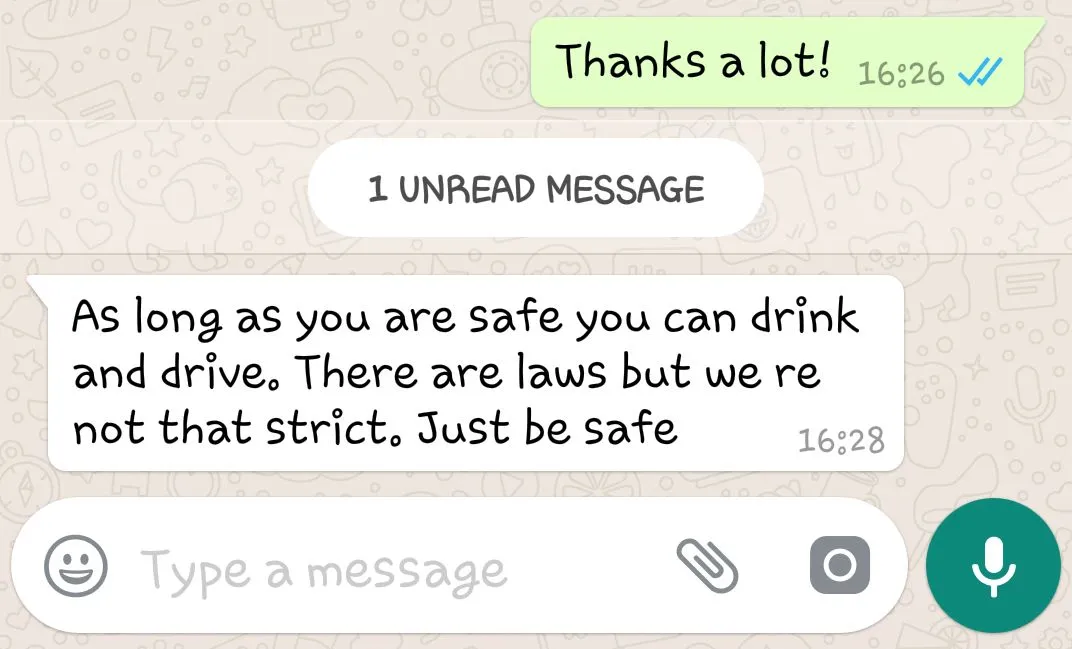
The next day we packed our bags and took off toward the island of Gozo in the midst of a super storm on the main island. I would like to add another public service announcement about driving in Valletta: Don’t do it. We had to drive into the city to pick up Rich and Cari and let me just make the point that cities that are older than 150 years were not built to accommodate automotive traffic. If someone has to make a three-point turn just to make a right turn, maybe your streets are too narrow. If a street is barely wide enough to accommodate a Toyota Yaris, maybe you should make it one-way. At one point one of the streets just… ended. We had to back up in reverse for a hundred yards avoiding pedestrians and hoping we didn’t get t-boned by cross traffic. A lot of f-bombs were thrown and I may have yelled at Dawn at some point (I apologized afterward so calm down). The two-hour drive to the ferry was boring by comparison and it was a short 20-minute boat ride to the island of Gozo. The four of us rented an old farmhouse in San Lawrenz toward the west side of the island near the former Azure Window. I thought the farmhouse would be in the middle of nowhere but we were actually in the center of a small village facing a somewhat busy road and (to Rich and Cari’s chagrin) a metalworking shop that opened at 7AM directly facing their room. The farmhouse itself was humongous with stone walls, tile floors, a giant kitchen and a nice pool. Dawn thought it was creepy. I asked our host Kevin how hard it would be to get a cab back to the place if we were out drinking and he replied with possibly my favorite text message ever. We went to a local grocery, bought too much stuff for three days and spent the rest of the evening enjoying Rich’s newfound penchant for making gin and tonic.
I’d like to take a brief interlude to discuss one of my favorite things about Malta: The names of stuff. Now I freely admit that I have no idea how to properly pronounce any of these words but how can you say “Dingli” and not laugh? Seriously, just try and pronounce some of this stuff and tell me you don’t enjoy it. Ggantija. Marsaxlokk. Dwejra. Rabat. Marsalforn. It’s so fun for your mouth! It’s like eating pop rocks! Dingli. Sliema. Gozo. Marsalforn. Maaaarsalfooorn. That one is my favorite.
We started our first full day in Gozo at 2PM due to the aforementioned gin and tonics and embraced the hair of the dog by visiting the Lord Chambray brewery. It was surprisingly well-equipped for a tiny microbrewery and they told us they distribute not only in Malta but also internationally. The beers were just OK, though, and this proved to be an omen for the majority of microbrews we were to sample on the trip. Our next stop was the Unesco world heritage site of Ggantija, another set of megalithic temples dating back to 5600 years ago. These structures were much larger than the ones we visited previously but also much less well-maintained. You’ll be able to see from the picture that most of the stone structures have eroded considerably although still inspiring amazement. We continued to the north coast of the island to visit the salt pans near Marsalforn which are essentially squares and rectangles carved directly into the flat surface of the cliffside. From there it was a short trip (well… everything is a short trip on Gozo) to the main city of Victoria for a visit to the Cittadella in the center of town. This old fortress has everything you would want in a medieval fortification: 360-degree views, a church, and most importantly cannons. The stone structures are a beautiful sandy color that is bright even on an overcast day. We ate street-side pastizzi and ftira then drove to Dwejra for a sunset on the cliffside.
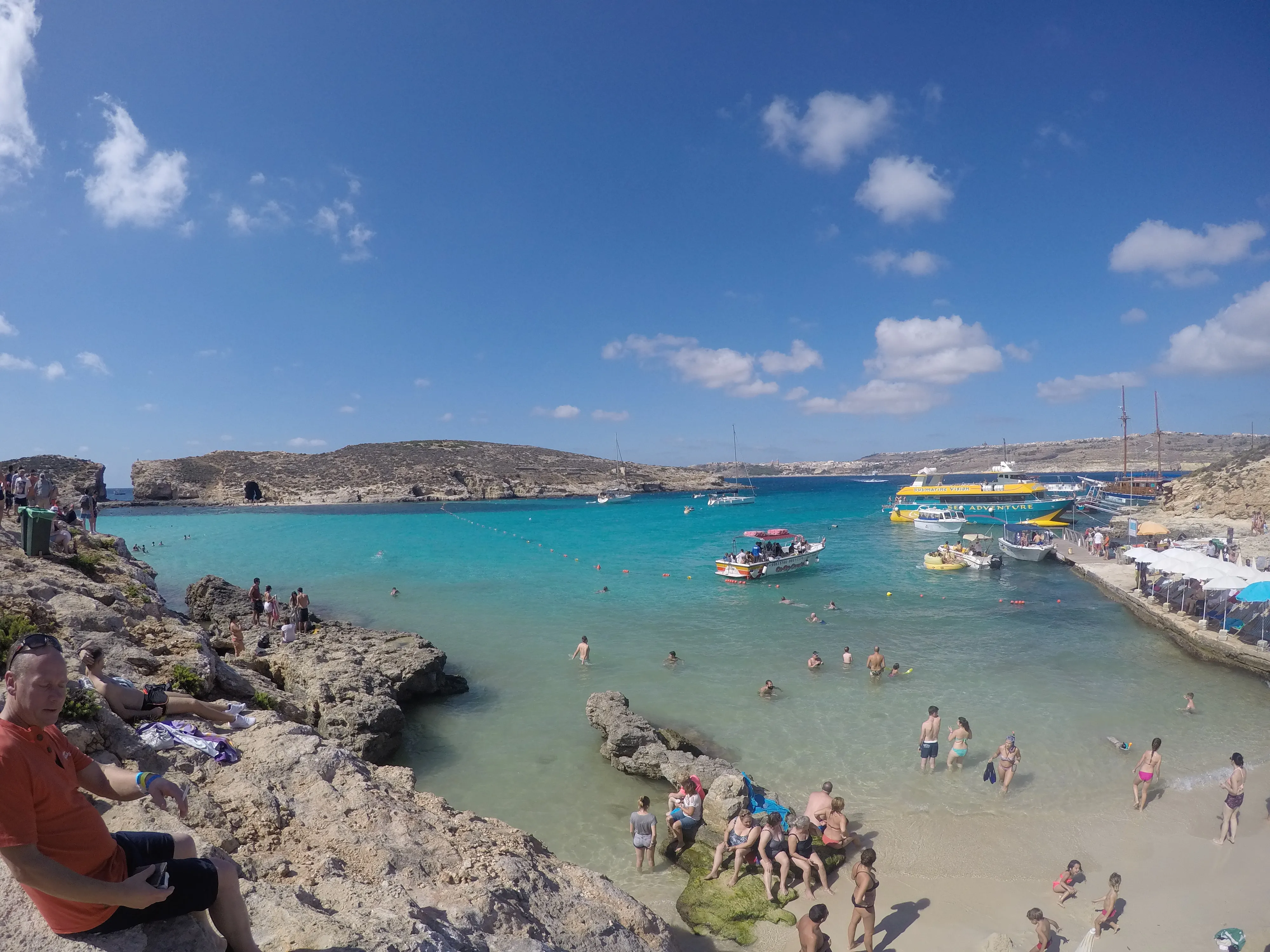
The next day we took the morning ferry to the small island of Comino which is home to one of the hundreds of locations in the world that call themselves the Blue Lagoon. This particular Blue Lagoon, while beautiful, had an ambiance reminiscent of Daytona Beach during spring break. The lagoon was pouring over with swimmers and sunbathers covered every square inch of the surrounding hillsides. Permanent food stall lined the footpaths near the pier leading to and from the lagoon. We legged it out of there for a long hike around the island and found an isolated spot called Crystal Lagoon where we could go for a swim in peace. We found another crappy beach on the north side of the island and then stopped for the worst lunch of our trip at Comino’s only hotel. We made it back to the Blue Lagoon by mid-afternoon for a quick swim before braving the free-for-all on the pier for the afternoon ferry back to Gozo. Anonymity and anxiety really do bring out the worst in people, especially when there’s limited seating. I wish we could’ve seen the lagoon with only about 1/4 of the tourists because it really is gorgeous. I think the highlight of the day for me was the Crystal Lagoon or maybe the Lampuki pie at dinner. Lampuuuuki.
Our last day in Malta found us heading back to the capital Valletta on the main island for its yearly Notte Bianca festival. Rich and I dropped off our trusty Toyota Yaris at the airport and made it back to the city in time to meet the ladies for a fancy late lunch of Maltese antipasto. Most of the streets had been restricted to pedestrian traffic as floats and stands were being prepared throughout the town. We had drinks at a bar whose table service was on a street that sloped 30 degrees and then moved on to an accidental 7-course meal that lasted over two hours. It was probably our best meal in Malta even though we didn’t know it was going to be 7 courses so if you find yourself in Valletta make sure to eat at Legligin. Legligin. Legliiiiigin. Anyhow we spent the rest of the night wandering down crowded streets enjoying open-air art exhibits and all kinds of music from gospel to rock to techno. The stores and shops were all open and we walked by a few places offering free shows. Then it started to rain so we went to bed and thus ended our time in Malta.
Here’s a short video with a sort of walking tour of some of the places we visited on our trip. You’re probably better off clicking into YouTube and turning up to HD:
https://www.youtube.com/watch?v=rNAHM__DNYU
Malta is definitely worth visiting. One week was a good amount of time since we saw just about everything we wanted to see except for the Blue Grotto. That was due to the weather, though, not to a lack of time. Everybody speaks English with an accent that sounds almost middle eastern and when they speak Maltese about a third of the words sound just like Italian. The food is good, the sea is beautiful, it’s not expensive, and most of all it has an incredible history. But most of all… Maaaarsalfooorn.
Next up, Sicily.
Take ‘er easy,
Dave